Bijay Kishan
LIFECYCLE EMAIL SYSTEMS FOR D2C & SAAS
Built and deployed at Streamoid Technologies · AI SaaS for fashion & retail brands
I build lifecycle email systems that recover lost signups and turn them into revenue.
Most brands send the same emails to everyone. I build systems that adapt based on user behavior — built from scratch, not optimized from an existing setup.
The proof below comes from a SaaS company. This is the system D2C brands paying for traffic but not converting it on the backend are missing.
The result in one line
No email marketing. No follow-up. Just churn.
6 months later: 47.7% open rates — reactivating signups that would have been lost — two live automated flows, and a system built to scale without manual work.
If you're paying for traffic and not converting it — this is what you're missing →
01 — The Problem
Zero infrastructure. Every signup disappearing.
Streamoid Technologies is an AI-powered SaaS company with three products serving fashion and retail brands. They had a growing user base — and zero email infrastructure to support it.
No welcome sequence. No automated flows. No sender reputation. No segmentation. Every signup that didn't convert immediately was gone — no second chance, no nurture, no recovery.
Signups were being acquired and immediately lost. Every new user who didn't activate on their own was dead revenue.
Led end-to-end execution across strategy, copy, and implementation — built from scratch, in 6 months, solo.
02 — What I Built
Four phases. One complete growth engine.
Before touching a single subscriber, I ran 8 structured warm-up campaigns over 6 weeks to establish sender reputation with email providers. Skip this step and your emails go to spam — permanently.
Before that, I handled the full technical foundation — domain authentication (SPF, DKIM, DMARC), DNS configuration, Klaviyo integration with the website, and PostHog connected to Klaviyo so user behaviour on-site could trigger the right automated flows. This is the infrastructure layer most email setups skip — and why deliverability fails before a single campaign goes out.
Open rates across warm-up batches ranged from 15% to 60%, confirming clean deliverability before any real campaigns went out.
I designed, wrote, and launched Streamoid's first automated welcome sequence — a conditional flow that didn't treat every subscriber the same.
Built and executed end-to-end — strategy, copy, logic, and implementation inside Klaviyo.
Day 0: New signup enters the flow. Welcome email goes out immediately.
Day 2: Flow checks one thing — did they open Email 1? If yes, they enter a higher-intensity engaged path. If no, re-engagement path. Same list, two completely different experiences. This prevents engaged users from being slowed down and disengaged users from being lost.
Completion: Subscribers automatically moved to a "Completed" list — ready for the next campaign without any manual work.
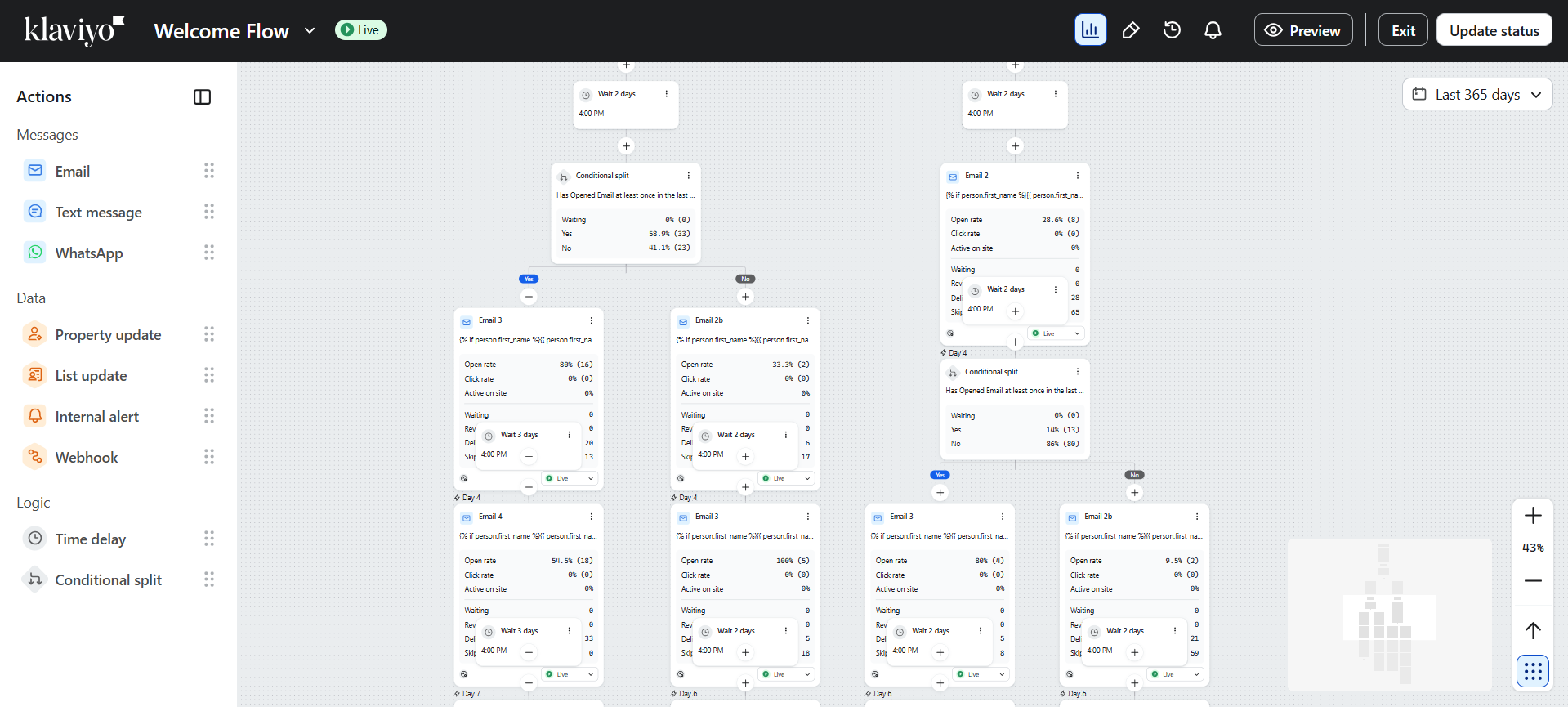
Sample size: first 149 users through the flow · Early-stage signal, but directionally strong across all segments
After the Photogenix flow was live, I identified a bigger structural problem. Streamoid had three products — Photogenix, Artifax, and Catalogix — but email was siloed. A Photogenix user never heard about Artifax. Cross-product revenue was being left on the table at zero acquisition cost.
I proposed a unified strategy to leadership and built a 5-email sequence covering all three products under one brand, with click-based personalization that automatically routed subscribers into product-specific paths.
This unlocked cross-product exposure without spending an extra rupee on acquisition.
Email 2 pivot point: Subscriber clicks a product button → Klaviyo tags them automatically → they enter that product's path for Emails 3–5.
Multi-click fallback: Subscriber clicks multiple products → receives a clarification email → then enters the right path.
No-click fallback: Subscriber doesn't click → stays in general path covering the full suite.
102 subscribers entered this flow. Email 1 opened at 23.5% — expected for cold B2B signups across a broader audience vs. warm product users. The infrastructure and personalization logic is what this phase was built to establish.
A system is only as good as what's written down. I documented everything so the team could own it after me.
Full email strategy document — flow logic, segmentation rules, conditional splits, fallback paths
User guides for Streamoid CXO, Artifax, and Photogenix
Blog content system for consistent long-term output
03 — The Result
From 0 → every signup captured, segmented, and moving toward revenue.
Before: every signup that didn't self-activate was gone. No follow-up. No recovery. Dead revenue.
After: every new signup enters a structured behavioral flow — segmented automatically, nurtured based on what they do, and moved toward activation without manual work. Two live flows. Warmed domain. Complete documentation. A system the team owns and can scale.
Previously wasted acquisition is now recoverable revenue.
Even a 5–10% activation lift from these flows compounds directly into paid conversions — especially for brands already spending on acquisition.
What the team said
"Bijay played a pivotal role in building email marketing from the ground up during the launch of our AI photo studio product. He demonstrated strong ownership and took charge of the initiative. His go-getter attitude, combined with his disciplined, well-planned approach helped us successfully launch and establish a strong foundation for our marketing efforts. Bijay is someone you can rely on to take initiative and execute smoothly."
— Tanvi Khanna, Former Product Manager, Streamoid Technologies
Tools used
Work with me
Get a free teardown of your email system.
I'll map your missing flows in 30 minutes and show you exactly where revenue is leaking. No obligation.
This is for you if
✓ Running paid ads but not converting signups
✓ No structured welcome or cart recovery flows
✓ Tired of one-size-fits-all email blasts
✓ Want email running automatically, not manually
Not the right fit if
✗ Already running advanced lifecycle marketing
✗ Looking for daily campaign management
✗ Need a full-service agency setup
Foundation
Email Foundation Package
$800
Early-stage pricing · Limited builds available
Full email audit — flows, gaps, missed revenue
Welcome sequence — 5 emails, written + built in Klaviyo
Abandoned Cart sequence — 3 emails, written + built
Segmentation + trigger setup
90-day campaign plan mapped to your sales moments
Live and sending within 4 weeks
Add-on
Technical Setup
$150
For brands starting from zero
Domain authentication — SPF, DKIM, DMARC
DNS configuration
Klaviyo–Shopify integration
30-day email warm-up plan
Or email me directly — hey@bijayph.com
I'll walk you through what's missing and what I'd build — then you decide if you want help implementing it.